NextDoor: reorganizing a local-news mobile experience
A concept redesign focused on clearer navigation, visible source cues, and reusable patterns for editorial and community content.
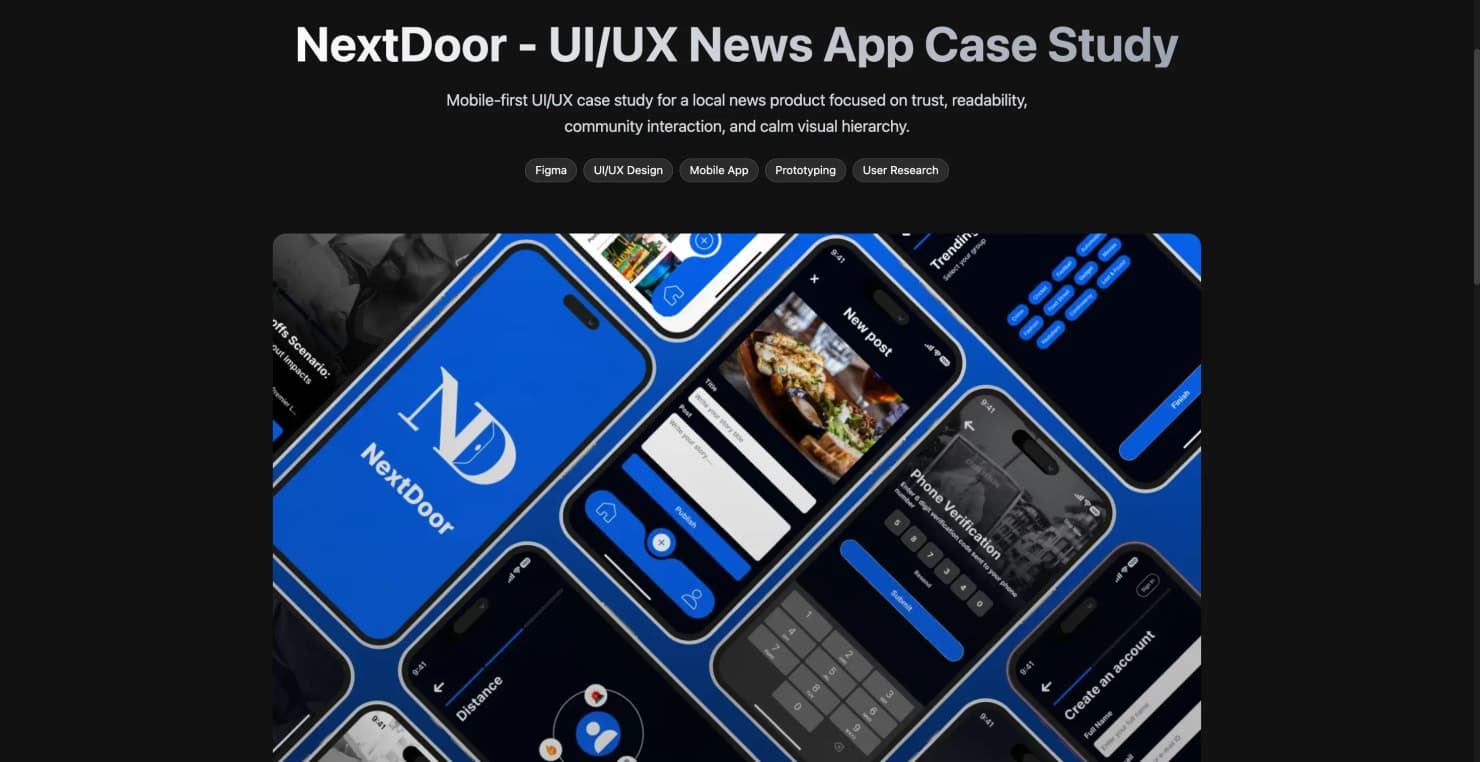
Navigation, story cards, and community content from the redesign.
- Role
- Product and UX design
- Year
- 2023
- Status
- Concept redesign
- Focus
- IA · Trust cues · System
Problem
The existing concept made readers move through several navigation levels before reaching relevant local stories. It also separated source and locality cues from the point where a reader decides whether a story is worth opening.
Why it mattered
A local-news product has to help readers judge relevance and trust quickly. When navigation reflects internal categories more than reader intent, finding a useful story takes longer and the interface feels less dependable.
Constraints
This was a redesign exercise, so the concept kept the broad content model and focused on what the interface could improve: grouping, hierarchy, navigation, source cues, and reusable components.
Information architecture
I regrouped content around locality and reading intent, brought community content closer to editorial content, and reduced the number of layers in the proposed navigation. The aim was to make relevant stories easier to reach without flattening the content structure into one feed.
Interface system
Story cards carry source and locality cues where readers make the open-or-skip decision. I expressed those cues, navigation elements, and community surfaces as reusable Figma components so related screens followed the same rules.
Outcome
The redesign produced a clearer proposed navigation model and a reusable mobile design system. As a concept, its value is the product reasoning and implementation-ready structure, not a claim about production adoption or measured engagement.
What I learned
Trust cues work better when they are part of the repeated interface pattern. Treating source and locality as component-level information made them harder to omit and easier for a reader to recognize across the product.
About this project.
Was the redesign released?
The portfolio presents NextDoor as a concept redesign. It demonstrates information architecture, interaction, and design-system decisions; it does not claim production adoption or business results.
What did you change?
I proposed a shallower navigation model, reorganized content around locality and reader intent, moved source cues onto story cards, and built the repeated interface patterns as a Figma system.
How does this support your engineering work?
The component structure was designed with implementation in mind. Repeated states and source cues map naturally to reusable frontend components rather than separate screen-specific markup.
Let's talk about your build.
If you need someone who can run the research, design the UX, build the system, and ship the product, start with a 30-minute call. No pitch, straight answer on whether I can help.